

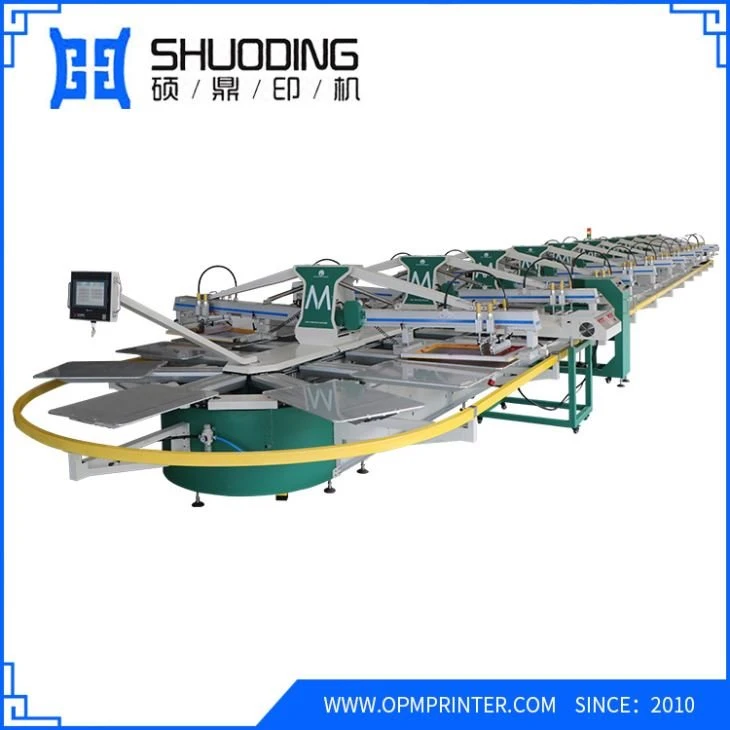
The automatic screen printing machine is equipped with a precise registration system that uses high-resolution cameras and sophisticated image recognition software to ensure accurate alignment of designs on different surfaces. This ensures minimal errors and waste in complex multi-color prints. The machine can handle various materials and substrates, including paper, fabric, plastic, glass, and metal, providing versatility in printing applications.
Your Professional Automatic Screen Printing Machine Supplier
Wuxi Shuo Ding Printing Equipment Co., Ltd. was founded in 2010, always adhering to the "honest and trustworthy, quality first, serving the customers in full-service " business philosophy. At present, the main products are: oval printing machine, piece-cloth printing machine, cutting printing machine, umbrella printing machine and other three categories of more than a dozen models, which are widely serving the garment, umbrella, luggage, shoe materials and other industries of printing processing enterprises.
Rich Experienced
Our production team has nearly 15 years of production experience, we constantly introduces innovative fabric production equipment, and provides you with equipment integration design solutions.
Wide Range Products
Our product range is rich, including more than a dozen models of equipment in three categories, such as fabric printing equipment, dryers, dyeing machines, stretching machines, etc.
Quality Assurance
Our production process complies with ISO standards, and all products obtain TUV certification and CE certificates, ensuring high-speed printing, excellent print adhesion, and long-term operation.
Customized Services
According to the needs of different customers, we provide size , apperance and function customization services for our products, and support OEM orders.

T-shirt oval printing machine is widely used in tailoring and printing materials such as T-shirts, bags, shoes, leather, etc. Especially suitable for printing with high number of teeth. Our machines can be combined with digital printing machines, flocking machines, and pressing machines to realize various printing processes on one machine.

Automatic Elliptical Screen Printing Machine
Automatic elliptical screen printing machine innovatively adopts integrated steel frame forming, CNC milling, processing and drilling. It is 300% stronger than the traditional aluminum frame structure and has an effective service life of more than 10 years, laying a solid foundation for accurate printing quality.

Fully Automatic Oval Screen Printing Machine
The fully Automatic oval screen printing machine is suitable for all kinds of screen printing, used for automatic printing and manual printing, not limited to printing of large-size pieces and clothes.

Oval T Shirt Screen Printing Machine
Especially suitable for printing with high number of teeth. Our machines can be combined with digital printing machines, flocking machines, and pressing machines to realize various printing processes on one machine.

Oval Tshirt Silk Screen Printing Machine
The oval tshirt silk screen printing machine is based on the rotary screen printing machine, and its performance and printing process are very good. The machine adopts modular design and high-strength aluminum alloy structure.

T Shirt Oval Screen Printing Machine
T Shirt Oval Screen Printing Machine belongs to the most representative printing equipment in the hole printing machine. Its printing plate is a vertical and horizontal, latitude and longitude mesh woven by silk screen and other materials.

T Shirt Automatic Screen Printing Machine
The machine adopts modular design, high-strength aluminum alloy structure, and the main rotating system adopts high-precision servo drive to ensure fast and stable operation.

Fully Automatic Screen Printing Machine
The full range of Fully automatic screen printing machine we provide is suitable for soft and semi-soft materials of 100-35g/m2. This Fully automatic screen printing machine is specially designed for precision work and can only be operated by one person.

Automatic Oval Digital Printing Machine
The automatic oval digital printing machine is based on the rotary screen printing machine, and its performance and printing process are excellent. The machine features a modular design and high-strength aluminum alloy structure.
Advantages of Automatic Screen Printing Machine
Speed
Automatic screen printing is built for speed, producing orders much more rapidly than manual printing. Production moves more quickly and easily. While requiring less physical work and time, an automatic screen printing machine allows you to scale up your business and pass on the cost savings to your customers.
Reduce Labor Needs
Automatic screen printing machines require less labor compared to manual presses. You need fewer (or even no) employees for a quicker output, giving you the independence to continue taking on orders even when hiring good employees is difficult. This will give you more time to build out your business and find new customers while continuing to provide excellent support to your existing customers.
Protect Yourself
Screen printers will also be thrilled to save their bodies from the ongoing physical wear and tear of manual printing. Talk to any manual printer and they'll tell you the toll it takes on their shoulders, elbows and hands over the years. An automatic screen printing machine does all the labor for you.
Consistency
The consistency of automatic screen printing machine printing also reduces human error. With no adjustment needed, the machine automatically prints the right colors in the right spot every time. No matter how good a printer is, they start to get tired as the day goes on and not be as consistent with squeegee pressure, flash times and more.
Flexibility
An automatic screen printing machine provides the flexibility to offer more high-color options and a diversity of jobs, including large orders.
Long-Term Needs
As business needs grow, equipment needs change. While automatic screen printing machines are more expensive than manual machines, you will see the returns of your investment quickly. If you plan to stay in the business for years, an automatic screen printing machine will quickly pay for itself.
Working Principle of Automatic Screen Printing Machine
Printing is carried out using the basic principle that the graphic part of the screen printing plate is permeable to ink, and the non-graphic part is impermeable to ink. When printing, pour ink onto one end of the screen printing plate, use a squeegee to applya certain amount of pressure on the ink part of the screen printing plate, and at the same time move it toward the other end of the screen printing plate. The ink is squeezed by the scraper from the mesh of the graphic part onto the substrate during movement. Due to the viscosity of the ink, the imprint is fixed within a certain range.
During the printing process, the scraper is always in line contact with the screen printing plate and the substrate. The contact line moves with the movement of the scraper. Since the screen printing plate and substrate A certain gap is maintained between them, so that the screen printing plate during printing generates a reaction force on the scraper through its own tension. This reaction force is called rebound force. Due to the effect of resilience, the screen printing plate and the substrate are only in moving line contact, while other parts of the screen printing plate are separated from the substrate. It causes the ink and screen to break apart, ensuring the printing dimensional accuracy and avoiding smearing of the substrate. When the scraper scrapes across the entire page and then lifts up, the screen printing plate also lifts up and gently scrapes the ink back to its original position. This is a printing stroke.
Manual vs. Automatic Screen Printing Machine: Key Different?


The Physical Challenge of Manual Screen Printing
Since, manual screen printing is more physically demanding, the final design relies heavily on the physical abilities of the screen press operator. Experience and accuracy training are necessary for preparing your custom t-shirts for printing. Factors such as alignment and knowing how much pressure to apply to the blade to control the amount of ink being applied to the t-shirts requires continuous practice and skill. When placing an order with a company that uses a manual printing press, it is important to consider the likelihood of repeat orders and whether consistency between the orders is an essential requirement. Differences between your custom t-shirt orders can occur since the pressure applied to the blade may vary based on the person that operates the manual printing press. So, if you plan to make multiple repeat orders with a company that uses a manual printing press, potential inconsistencies in your orders are a key factor to think about in your decision-making process.
Small Print Runs Are Best for Manual Presses
Manual screen print presses are ideal for small run orders. Many companies that operate automatic screen-printing presses have a minimum quantity for screen-printed custom t-shirt orders. In automatic screen-printing it is time-consuming to make each screen and then load them onto the machine for each colour. As such, it would be unproductive to put in that amount of work into producing a few custom t-shirts, as opposed to a large batch order. Since the overhead costs of operating a manual screen-printing press are significantly lower, companies continue to make a profit by screen printing these smaller run orders.
The Speed of Automatic Screen Printing Machines
Speed is a leading reason why custom apparel companies invest in an automatic screen-printing machine. An automatic screen-printing machine can print 4000-5000 custom t-shirts during an 8-hour shift. This is compared to a manual press that produces only 400-500 custom t-shirts in the same time period. The shorter production and turnaround times are ideal for handling large run orders.
When Consistency Is Key
If maintaining consistency amongst your garments in areas such as logo placement and high print quality are essential, then automatic screen printing is the best option for your custom t-shirt orders. For instance, large events like a charity run require custom t-shirts for hundreds of participants and automatic screen-printing will ensure your order preserves a uniform image. An automatic screen-printing press can print a large run in a short period of time, while ensuring the exact same amount of pressure on the blade is used to apply the ink to the garment. This ensures your custom t-shirts maintain a uniform look, while speed is prioritized to prepare your order in a timely manner.
How Do You Know it's Time to Upgrade to an Automatic Screen Printing Machine?
Question 1: Can You Keep Up?
Every screen printer loves when orders come piling in. But what happens if it becomes too much? If you can't keep up with the daily workload, it might be time to upgrade. Many printers that end up choosing to upgrade to an automatic press find that there just isn't enough time in the day to keep up with the orders coming in the doors.
Another question to ask yourself is this: are you considering buying another manual press to keep up with production? Many printers keep their small press for simple jobs or live screen printing events. But if you're considering investing in another high-production manual press, it might be worth your time and money to choose an automatic press instead.
Question 2: What's Your Order Volume?
The average order volume looks different for every shop. Some printers constantly take large jobs, while other shops stay small in order volume. So how do you know it's time to invest in an automatic press to help with those orders?
If your shop is printing lots of orders of 50 garments and under, automation won't necessarily increase your production capability. However, if you're starting to exceed orders over 50 pieces regularly, getting an automatic press can be helpful.
Set up and tear down of jobs are similar whether you're a manual or automatic printer. You still need to burn the design, register the screens, take it all down, and reclaim it once the job is done. The advantage of having an automatic press comes in the production "run rate." A one-color job will run a little faster on an automatic than a manual press. The more colors a print has, the better the run time on an auto will be compared to a manual press.
Question 3: Should You Hire an Employee or Go Auto?
There are two main methods to increase your production. Either invest in an automatic press or hire more people to help you run the current press you have. Some print shops benefit from hiring help, while others find that going automatic helps them more than another employee.
Two ways to increase production: through automation or other means (hiring more people, another manual, etc.) based on the volume of individual orders.
This decision depends on a couple of factors. First up, order volume and type of garment. Let's say you print a lot of jobs that have 24-50 pieces but are made of different garments. The customer wants 24 t-shirts, 16 hoodies, and 15 poly-blend garments. Each type of garment will need different colors and a change in off-contact. For a job like this is best to print on a manual press, since the automatic press has more to change between garment and color types.
A Beginner's Guide to Buying an Automatic Screen Printing Machine
Press Configuration
First, you need to determine what press configuration you'd like. How many colors would you like to be able to print on a given run, and how many stations do you need? You likely have a good idea of the configuration you'd like based on your current printing capabilities and customer demand. As you consider color capabilities and stations, keep in mind that on certain jobs, a flash cure unit or a white underbase screen might take up a station, reducing your color capacity. If you're able to, you might want to buy one step up from the configuration you think you need; the cost difference might be minor but a slightly larger press configuration will allow you shop to grow into your press over time. A smaller press might have you feeling like your shop has outgrown its capabilities within a few years.
Size
Of course, another consideration that directly correlates with your press configuration is size. Your press has to fit within the floorplan of your shop, with room for your employees to operate the press and maneuver around. Measure out the footprint of the press you're considering and add two to three feet around the press to allow for operation and maintenance. Make sure you factor in the need for any support equipment, such as an air compressor and chiller, as well as any other new equipment you might need when you upgrade your press.
Pneumatic or All-Electric?
Automatic screen printing machinees have long been powered by compressed air, but the newer generation of presses has gone all-electric. You'll have to determine whether a pneumatic or an all-electric press is right for your shop. An all-electric press can help you fit a larger press configuration into a smaller shop space because it doesn't come with the need for an air compressor and chiller. Electric presses also bring less maintenance because you don't have to worry about problems with the compressor or air lines interfering with operation.
Features
From one model of automatic press to another, the special features are what largely set different machines apart. You'll have to determine if you want an automatic with basic controls or if you prefer the precision of high-tech computerized controls. Screen clamps, off-contact controls, squeegee setup, step-back capabilities, safety features, pallet leveling systems and lubricating systems, among other things, are all features you'll have to compare and consider as you shop.
Support Equipment
Your focus might be on upgrading your shop with an automatic press, but you might have to upgrade additional equipment to ensure that the rest of your shop is ready for the demand of an automatic press. Is your exposure unit the right size for the larger screens most automatic presses use? Is your dryer system large enough to accommodate the increased production level? You won't benefit from the production capabilities of an automatic press if your dryer can't keep pace.
Shop Setup
As you shop, you also will have to be sure that your shop will accommodate the demands of an automatic press. That might mean upgrading from the one-phase electric system that most homes and businesses have to a three-phase system. If you choose a pneumatic press, you'll need room to run air lines and electric hookups for your compressor. When you narrow down your press options to a few finalists, you'll want to ask what hookups you need in your shop to power the press.
Financing
When shopping for their first automatic press, many screen printers are met with sticker shock. There's a wide price range for automatic screen printing machinees, and a large press can be expensive. Fortunately, most businesses can find financing for their presses, whether it's a loan or leasing. To determine what you can afford, figure out what monthly lease or loan payments would be and what your production and per item profit would have to be to make that worthwhile. Generally, the higher volume capabilities of an automatic press make it easy to earn the profit necessary to afford the machine.
Ultimate FAQ Guide to Automatic Screen Printing Machine
Q: How does an automatic screen printing machine work?
A: As a general rule, the first step will be placing the material on rotating print pallets or a conveyor belt. It then passes under the mesh screen where automatic squeegees pull the ink through the screen to create the image.
Q: Can screen printing be automated?
A: Screen printing may be a relatively manual process but there are a number of automated options available.
Q: How many shirts can you screen print per hour?
A: So that means each shirt you are profiting between $3-$4. Take that and then print 40 shirts per hour on a small press or 100 shirts an hour on a larger screen printing press and you're making $120-$400 per hour! Not too bad for pushing ink huh!
Q: What are the 3 common types of screen printing presses?
A: There are three common types of screen printing presses: flat-bed, cylinder, and rotary. A development of screen printing with flat screens from 1963 was to wrap the screen around to form a tube, with the ink supply and squeegee inside the tube.
Q: Is screen printing hard?
A: While the overall process is simple enough, there are lots of details to learn. Before you dive in and spend thousands on new screen printing equipment, take some time to learn about the process. Screen printing is process oriented – meaning that if something goes wrong, you may have to start over at the first step.
Q: Is there money to be made in screen printing?
A: In the US, the amount of revenue screen print shops make follows a fairly normal distribution. This means the overwhelming majority of shops collect revenues between $100,000 to $1,000,000. There are hundreds of shops with revenues above $1M. However, there are very few screen print shops with revenues above $5M.
Q: What should you not do when screen printing?
A: Mistake #1: Using a low-quality stencil.
Mistake #2: Not cleaning the screen before coating and printing.
Mistake #3: Not getting the right amount of emulsion to coat your screen.
Mistake #4: Using dirty or wrinkled materials.
Mistake #5: Not checking and correctly preparing your ink.
Q: Is automatic screen printing better than manual?
A: The advantage of having an automatic press comes in the production "run rate." A one-color job will run a little faster on an automatic than a manual press. The more colors a print has, the better the run time on an auto will be compared to a manual press.
Q: What is the best temperature for screen printing?
A: For curing screen printing inks on t-shirts, which is likely the most common item you'll be curing, you'll need to heat the fabric inks anywhere from 270-330 degrees Fahrenheit (depending on which screen printing ink you're using) to ensure that the design will adhere properly to the shirt.
Q: How many t shirt designs should I start with print on demand?
A: Start out with no more than 8 designs and 6 tees for each size in each design. That comes out to 24 tees per design (6S, 6M, 6L, 6XL) and a total of 192 tees across your entire line. That way, you can do an initial test run and see which sizes are selling the best for you, as well as which designs.
Q: What ink is used for screen printing?
A: Discharge inks, plastisol inks, and water-based inks are some of the most commonly used screenprinting inks. These inks have different properties suitable for different materials and print patterns. Working with these inks also require distinct skill sets and expertise.
Q: Does screen printing crack?
A: As for the cracks, all water-based acrylic inks, if used with low thread count screens, tend to develop cracks after drying. This means that the layer of ink, due to its thickness, doesn't expand along with the fabric as it expands, and so it splits.
Q: How does automatic screen printing work?
A: The auto screen printing machine pours ink on one end of the screen printing plate and uses a squeegee to apply a certain pressure on the ink position on the screen printing plate while moving toward the other end of the screen printing plate.
Q: How much space do you need for screen printing?
A: Your screen printing equipment can be set up in many different locations. You can use a garage, basement, an extra room in your house, or a commercial location. Our startup shop's space requirements range from a 10' square area or corner of your basement, to a 12' x 16' room.
Q: Which is cheaper screen printing or digital printing?
A: If you're planning a large order with the same design, screen printing becomes more cost-effective due to the economy of scale. For smaller orders or designs that require frequent changes, digital printing is more cost-effective and flexible, as it doesn't require the same initial setup.
Q: What material can you not screen print on?
A: Other common examples of synthetic fabrics to avoid for screen printing include acrylic, rayon, and acetate. Generally, these fabrics are heat-sensitive and/or tend to easily shrink.
Hot Tags: automatic screen printing machine, China automatic screen printing machine manufacturers, factory, business t shirt oval printing machine, new automatic elliptical printing machine, mini automatic elliptical printing machine, printers automatic elliptical printing machine, blue t shirt oval printing machine, t shirt oval printing machine sale


