

Introduction
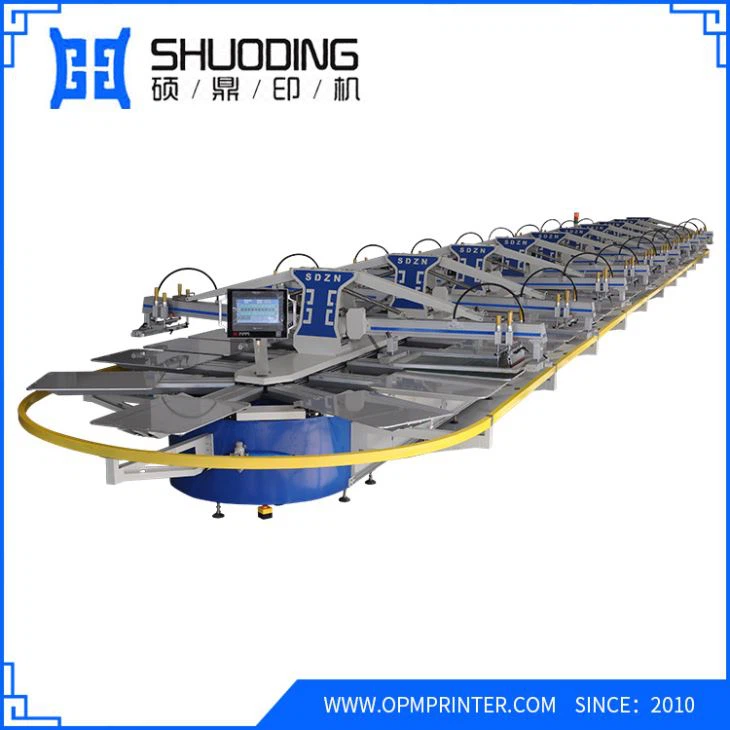
Oval Printing Machine uses a positioning system to fix the material on the printing platform and then transfers the design pattern onto the material surface. It is suitable for T-shirts, sweatshirts and other clothing materials, and can be combined with drying or curing processes to complete the printing process in mass production.
Product Details

Features
High-Precision Multicolor Printing
Each printing station is independently servo-driven, with a positioning accuracy of ±0.05mm, ensuring ghosting-free 16-color multicolor overprinting, suitable for complex patterns and brand logo printing.
Modular Expandable Stations
The standard model supports 6-24 stations, and stations can be added as needed without replacing the entire machine. Each station can be independently raised and lowered for easy screen replacement and maintenance.
Intelligent Drying and Glue Spraying System
Each station is equipped with an independent dryer and ultrasonic atomizing glue spraying device, maintaining uniform glue moisture and preventing screen clogging.
User-Friendly Control Interface
A high-end touchscreen combined with a PLC control system allows for real-time monitoring of production status, automatic fault alarms, remote control, and software upgrades. It can independently control the start/stop, pressure, squeegee angle, and printing sequence of each printing station.
Production Equipment

Customers visit the factory

Application
This multi-functional machine excels at various printing techniques, including water-based paste printing, oil-based ink printing, plastic ink printing, plastisol or paste printing, and flocking printing.
In addition to a wide variety of substrates, this machine can print on clothing, T-shirts, bags, socks, hats, fabrics, paper, leather, PVC boards, stickers, and many other materials.

Packaging and shipping

FAQ
Q: What is offset printing machine used for?
A: Offset lithography is the primary method used to print longer runs of magazines, books, manuals, brochures, direct-mail pieces, letterhead, posters, and paper-based labels and packaging.
Q: What is plotter printing machine?
A: Plotters are used to print out huge graphs, designs, and other types of paper-based documents, such as engineering drawings, business charts, construction maps, and architectural blueprints. A plotter is a freestanding device with a CPU of its own, or it is a computer added as a peripheral to another computer system.
Q: Can a plotter be used as a printer?
A: Plotter printers are commonly used in the engineering and architectural industries to create large-scale technical drawings and blueprints. They are also used in the printing and sign-making industries to produce banners, decals, and other large-format prints.
Q: What are the advantages of rotary printing?
A: With high speeds that can print up to 120 yards per minute, rotary screen printing's production speed is incomparable. Rotary screen printing does not require long cleaning or resetting processes between print runs, which makes it extremely cost-effective.
Q: What is application of offset printing machine?
A: Offset lithography is one of the most common ways of creating printed materials. A few of its common applications include: newspapers, magazines, brochures, stationery, and books.
Q: What method is used in printing by the printing machine?
A: Offset printing is a widely used modern printing process. This technology is best described as when a positive (right-reading) image on a printing plate is inked and transferred (or "offset") from the plate to a rubber blanket. The blanket image becomes a mirror image of the plate image.
Q: What is the difference between screen printing and pad printing?
A: Screen printing is used on textiles, ceramics, wood, glass, metal, paper, and plastic. It can be used for balloons, decals, clothing, medical devices, product labels, signs and displays, printed electronics, and fabrics. Pad printing is used on plastic, glass, metal, rubber, and wood.
Q: What is print padding?
A: Padding adds blank space to the top, bottom, left or right of the layout that is sent to the printer. This helps compensate if your printer is cutting off part of your photo(s) or the margins or picture frames of your layout are not well aligned. Adding positive values to the padding will increase the margins.
Q: How often should you do printer maintenance?
A: The frequency of printer maintenance will vary depending on how often you use your printer. If you use your printer for personal use, you may only need to clean it once a month. If you use your printer for business purposes, you may need to clean it weekly or even daily.
Hot Tags: oval printing machine, China oval printing machine manufacturers, factory, Printing Machine, Free-alignment Piece Printing Machine, Disc Ink Printing Machine, Automatic Alignment Piece Printing Machine, Clothing Screen Printing Machine, Digital Cutting Machine
